Showing posts with label Lens Review. Show all posts

Thursday, January 25, 2018

Canon's 50mm f/1.8 Lenses

Canon's EF 50mm f/1.8 lenses have been a staple of the EOS system since its introduction in 1987. The so-called 'nifty fifty' is often the first prime lens owned by every Canon shooter and serves as the gateway drug to fixed focal length lenses and depth of field control. Since the initial release of the system there has been a total of three versions of this lens: the original EF 50mm f/1.8 from 1987, the EF 50mm f/1.8 II, which came out in 1990 and the recently released EF 50mm f/1.8 STM which debuted in 2015. The latter two are still available on the market while the original has been discontinued for some time but is still available on the used market thanks to its former kit lens status. For the most part, all three variants are very similar, employing similar optical formulas, compact dimensions, and lightweight construction. Stop down to f/2.8 and all these lenses produce very respectable results, while between f/4.0 and f/5.6 their performance truly overreaches their modest price point. Each version differs in key areas making the choice between them a tricky affair for those new to photography. I have been fortunate to have owned all three versions of this lens and I will share with you my experience with each (should you be planning to add a nifty fifty to your collection).

EF 50mm f/1.8

To this day some people prefer the original version of the lens for its solid build quality, metal mount,
and focus/depth of field scale. Used copies often sell in the second-hand market at a premium,  reflecting the more favorable attitude towards this lens over its successor. It is my least preferred version and I sold it soon after spending some time getting to know its quirks. It has the loudest autofocus motor I have ever heard in a lens, sounding more like a chainsaw than an optical instrument. The focus motor seems a tad bit slower than version II and, to me, its ability to focus accurately seems less sure, especially at f/1.8. The lens coatings are older than the subsequent versions and I found more flaring issues shooting into bright light. The aperture is of the 5 bladed variety which will give you harsher bokeh and pentagonal specular highlights when stopped down. Some people will find this cool and different (I must admit that I do) but most hate it. While it is said that the optics of the original version and version II are identical, in my experience it was the least sharp, especially in the f/1.8 to f/2.8 range. Whether this was due to the age of the lens or wear on the instrument, I cannot say.

Canon EF 50mm f/1.8The fact that the original version comes at a price premium is unattractive to me. The only real benefits are that the build really is better that the version II, the autofocus is faster than the STM version, and if you are manually focusing during video the distance scale can be useful. I recently discovered while trying to sell this lens that it does not work well with CMOS Hybrid AF, which is the live view autofocus system in Canon's Rebel and EOS M series cameras (from the EOS T4i through the T6i and EOS M through EOS M3). Normally this system works wonders but with the original 50 the system hunts back and forth a lot and seems to have a very hard time locking on to a given subject. Strangely it works just fine with Dual Pixel CMOS AF, ignoring the sound of tearing sailcloth coming from the focus motor.

EF 50mm f/1.8 II

Not only was the EF 50mm f/1.8 II my first prime lens but it was the first lens I ever purchased. 50mm on a full frame camera is perhaps my favourite focal length and it is in no small part due to this lens. It is cheap and cheerful, boasting the fastest autofocus among the three and managing to be a little less loud that the original. Being of all plastic construction it is easily the lightest and worst built of the three. I doubt this lens could survive any kind of drop or abuse. I know people with drawers in their houses with a few broken copies of this lens. The benefit of cheap construction is that it weights nothing on your camera which makes it a great addition to any bag. The fact that it can be bought used for $50-60 makes its purchase a no-brainer, while the low price point means you don't have to stress if it breaks. The aperture retains the 5 blade design.


For anyone on a budget or needing the fastest autofocus in the group, this is the version for you. If you are planning on mounting it on a camera and throwing it in your unpadded backpack or having it from a sling while you rock climb, this is definitely not the version for you.

EF 50mm f/1.8 STM

The newest version of this lens, the EF 50mm f/1.8 STM brings much-improved build quality, improved lens coating, and significantly quieter autofocus to the nifty fifty. When trying to grab an inconspicuous shot no longer will your intentions be announced by the buzzing of the focus motor. It's not as silent as the STM zooms, which are literally noiseless, but it is a vast improvement over its predecessors. While it does lack a distance scale, the STM autofocus system works flawlessly with the CMOS Hybrid AF and Dual Pixel CMOS AF, even supporting the rack focus speed control. Add in to the bargain a slight improvement in resolving power and a reduction in chromatic aberration, better contract, and we have a real winner on our hands. Another small gain comes from two more aperture blades, which smoothes out the bokeh somewhat. The best part is that the price is very similar to the previous version, meaning it's still the cheapest lens in the Canon system and probably the cheapest DSLR lens on the market besides the older version II. The biggest downside is that the autofocus is a hair slower that the previous version, though still very usable.


If you are using the lens for video work, the benefits of the STM focus system alone will steer you towards this new iteration. For the vast majority of still shooters, this is the best all-around solutions and is going to be the one to buy.


The bottom line is that all three version of this lens have something to offer, and if you can lay your hands on each version it will reward you with a unique shooting experience and, in the case of the original version, a bit of EOS system history. Each is capable of yielding great images but I heartily recommend the new STM version to everyone with an EOS camera. If you love or hate this lens, let us know in the comments below or share your opinions and photos on Twitter and Instagram using the hashtag #CorEx. You can also find me on Twitter and Instagram under @chrissomos. 


Sunday, March 1, 2015

The Most Tragic Bargain Canon Full-Frame Zoom Lens

Canon EOS shooters will note that until very recently there was only one full-frame zoom lens in the current lineup outside of the L collection and that lens was the venerable Canon EF 28-135mm f/3.5-5.6 IS USM. 


To the uninitiated this seems like an incredible value in a lens, especially given the current used prices which at time of writing hover around $200-$250 for a clean copy. It pulls together a very attractive list of features, discussed here in brief:

  • The relatively large zoom ratio is extremely useful and unusual for a full-frame lens. Wide on the wide end and long at the tele end, it makes for a spectacular walk around all-purpose lens. 28mm can pull in vast landscapes from the correct vantage point and show rich environments for portraits. 135mm offers a lot of compression for manipulating backgrounds and perspective for portraiture. 
  • Image stabilization partially offsets the slower aperture and cuts the shake in video capture. Despite being the first generation system it works very well.
  • The USM focus motor offers fast full time manual focusing which was rare for a lens in this class until the recent proliferation of focus-by-wire STM lenses. The large rubberized zoom ring feels excellent during use and the focal leng increments are more evenly distributed than those in comparable models. 
  • One aspherical element is present in the optical design which, again, was rare for an lens in this class until recently. It's not the sharpest lens, especially in the corners, but it's not a total dog either. Stopped down a little it can do the business, which is impressive considering the age of the optical design which dates back to 1998. 
  • The unit is lightweight compared to many of the other available full-frame zooms. 

It's not hard to understand why many new full frame Canon shooters give this lens a try. I've seen many copies mounted to cameras on the streets and at events at home and abroad. This was the second lens I purchased to use on my 5DII and it spent a lot of time mounted to my camera. It was usually the first lens in my bag and the one that usually stayed on in case I needed to pull out the camera at a moments notice to capture an image or a video. I loved this lens. It had a few nagging issues such as comparatively flat colour and incredibly noisy IS (it sounded like I had a lawnmower in the lens barrel) but they didn't bother me much at that point in my photography and it bore me many beautiful images and videos. As in many love stories, fate awaited me just around the corner to show me the depths of my own ignorance.


In the summer of 2014 I found myself packing my bags for a much needed trip to Europe and the EF 28-135mm f/3.5-5.6 IS USM secured a spot in my camera bag along with my EF 50mm f/1.8 II and my recently acquired EF 100mm f/2.8L IS USM Macro. Now let me just say that when I'm on vacation I tend to walk a lot. I mean A LOT. Eight to twelve hours a day isn't unusual, and my camera is hanging from my sling strap for a good portion of that time. My partner has impressed on me the value of walking the streets to get where I want to go in order to really get to know a city. I've whole-heartedly embraced this philosophy as it bears fruit in both the enjoyment of my travels and in photographic opportunities. Considering I spend the the balance of my time eating and drinking, it's also a good way to offset the calorie intake. Walking up and down the steep hillside that sketches the Pest side of the Hungarian capital, I first began to notice the zoom creep that plagues this lens. My copy had never given me much trouble before then but the jarring of each step seemed to loosen the inner barrel a little more. Hunting for shots up and down the mountainside it quickly became apparent to me that the tension was now completely gone in the zoom mechanism and the inner barrel fell to full extension each time the camera tilted downward, pulled earthbound by the heavy front element. 

Let me preface the following by stating that the build quality of this lens had never before seemed problematic to me. The sturdy plastics and smooth mechanism felt much more rhobust than many of the later consumer lenses in the Canon range. There was some wobble in the inner barrel but nothing that I considered a cause for concern. The new found zoom creep, while unsettling, didn't imediatly raise alarm bells. It is an older lens after all, and was purchased second hand from an older gentleman who had loved it well for several years. I continued to treck on with the occasional knock of the lens bottoming out, searching for the perfect vantage point to shoot Buda set against the Danube.  

At one point I raised my camera to my eye to frame a shot and I was alarmed by the sound of a distinct and frantic rattle within the lens that I can only liken to that of a spray paint can. My shock turned to horror when I turned the zoom ring and perceived no change to the focal length in the viewfinder. After a deluge of oaths and a brief inspection I had surmised that the mechanism connecting the different segments of the inner barrel to the zoom ring had somehow failed and left me with an impromptu challenge to shoot the rest of my travels with the 50mm and 100mm focal length (hmmm...sounds like another blog post.) 

Fast forward almost a month, 1400 images and almost 60 minutes of video later, I was home and eager to tear down the lens and find out why my lens love had so tragically ended her life on our European getaway. I took to the Internet to try and find a tear down guide and was quickly confronted with the disconcerting reality that I was far from being one of the few unlucky owners of this lens who experienced this failure. Indeed, the prevailing discussions online  seemed to suggest that this is an inherent design flaw in the lens and that this failure is extremely common. Being someone who meticulously researches my purchases online for hours before buying anything I was shocked that this little tidbit of information had not surfaced in any of my research.

Luckily I was able to find an exploded parts diagram of the lens and a few tear down posts that helped me open up the lens. Now is a good time to mention that I had never taken apart a lens before and doing so is not for the faint of heart. The only reasons I did was because I had already written off the lens as the cost of sending it for repair would be nearly more than the current value of the lens. After carefully taking apart the lens my suspicions were confirmed; the guide pin (YA2-3139, if anyone is curious) that runs in the channels at the rear of the inner lens barrels to coordinate their movements had rattled loose and eventually fallen off from the repeated impacts of the lens bottoming out. It is secured in place by two microscopic screws (XA1-3170-259.) I'm not sure who thought that was a good idea but I'm sure they probably no longer work at Canon for exactly that reason. At that moment I also realized I no longer had in my possession those two screws which I needed to reinstall the pin and set my lens to right. I quick call to Canon secured me 4 of them, but I must warn the hopeful reader that even those 4 screws had to come from japan and the parts rep informed me that the part was discontinued and I was lucky to be able to even get them. I doubt they will be available for much longer, if at all. My lens now sits on my shelf beside a bag of rare screws, waiting for its next turn on the operating table.

Now seems like a good time to resume some of the negative aspects of the EF 28-135mm f/3.5-5.6 IS USM, minor as they may be:

  • The lens produces noticeable distortion at both ends. This is easily corrected in post, but results in some loss of critical sharpness. If you were worried about critical sharpness however, you would not be using this lens. 
  • The colours and contrast are not as nice as many other lenses. Not a huge issue but still noticeable. 
  • The IS is not as sophisticated and noisier than some of the newer systems. On start up it jumps, shifting the frame momentarily before settling back into its place of origin. This is so brief and predictable that I never found it to be much of a problem but some find it distracting. 
  • The variable aperture is fairly slow, particularly at the tele end. Inconsistent aperture is also a problem if you plan to zoom the lens during video capture, where you will experience a change in the exposure of the video.

In my eyes the benefits of this lens, design flaw aside, far outweigh the drawbacks at the given price point. However, due to this lens' propensity for mechanical failure I cannot recommend that anyone buy it. The failure of this lens hamstrung me in such a vulnerable situation which, while not statistically relevant, left a terrible taste in my mouth.

A beautiful redhead has now taken the place of my old EF 28-135mm f/3.5-5.6 IS USM and I couldn't be happier. The optical and mechanical performance is superior in every way and I picked up a used copy for less than double what I paid for the old lens. It's worth noting that since the EF 24-105mm f/4L IS USM and the EF 24-70mm f/4L IS USM are bundled in kits with Canon's full frame cameras there is an abundance of copies in the secondhand market and you can negotiate very aggressively (i.e. low ball) the multitude of sellers until one cracks. I've seen both go for as low as $600. The new Tamron SP 24-70 f/2.8 DI VC USD and the celebrated Canon EF 24-70mm f/2.8L USM can be picked up used for $800-$900 at the time of writing.


Here is a collection of further reading on this lens if you want to learn more about it:


If you would like to see some images taken with this lens please head over to my Flickr page.


Images

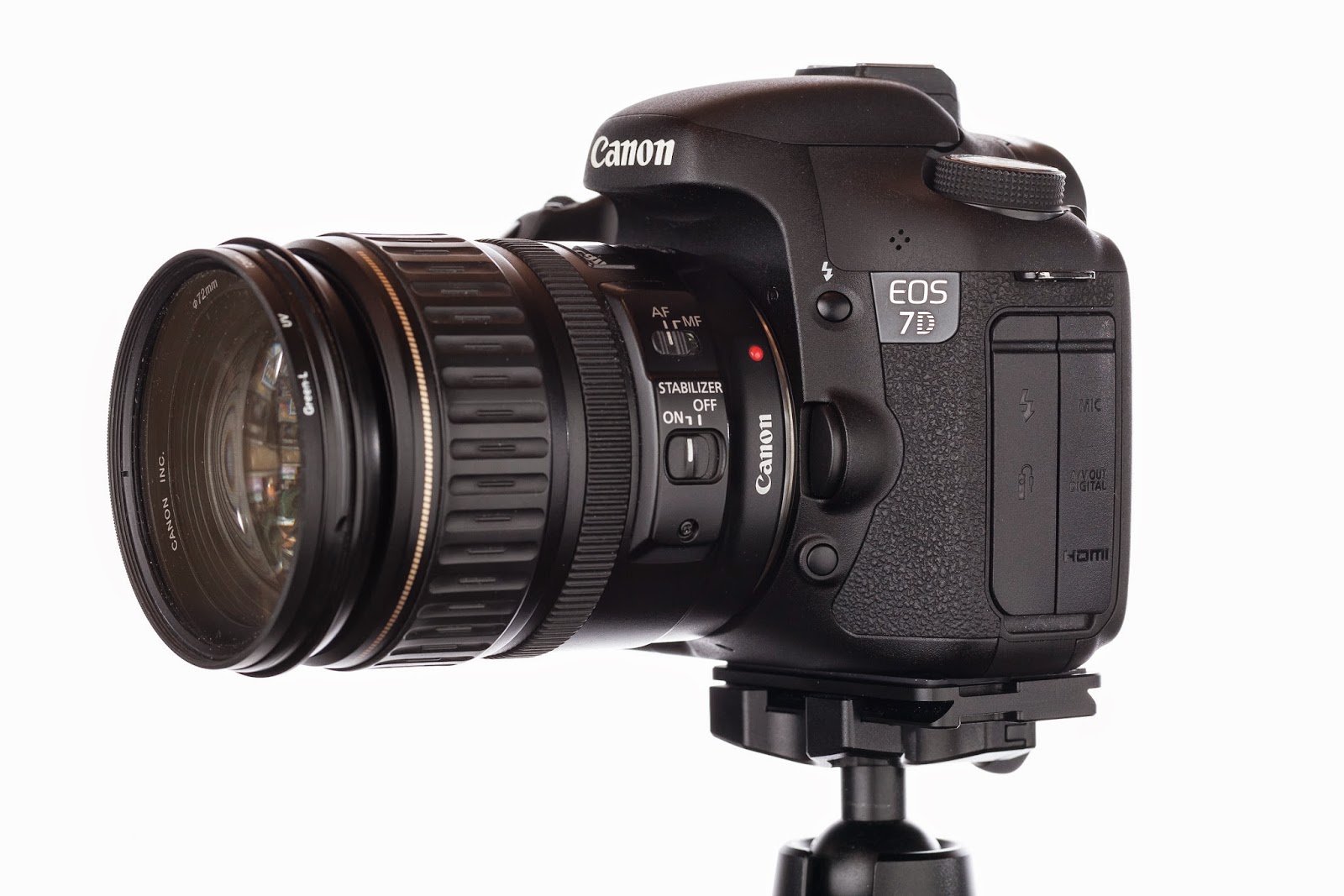
Here are some images of the shoot I did for this post. If you read my previous post about evolving product photography at home, you may have noticed that I've put into practice some of the ideas I derived from my last product shoot. Upon reviewing my images from this shoot I noticed my challenge was controlling reflections on the many shiny surfaces of the camera which I believe I can attribute to the lights being to close to the subject and having such prevalent hot spots despite the umbrellas and the diffusion flaps on the speedlites being down. Something to work on for next time.